Research
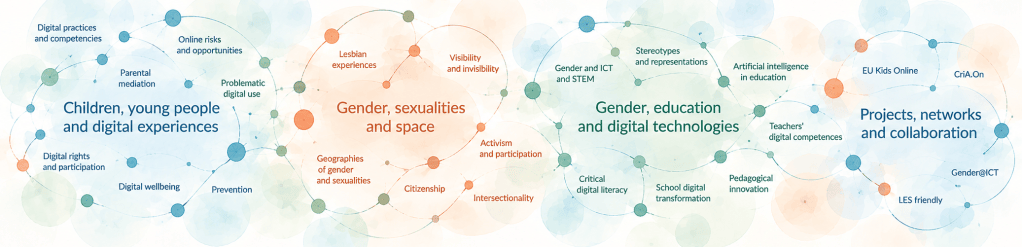
My research explores the intersections of gender, sexualities, digital technologies, education and social inequalities. From an interdisciplinary perspective, I examine how power relations shape experiences across physical and digital spaces, combining empirical research with critical analysis and dialogue with professionals, institutions and civil society.
1. Children, young people and digital experiences
I study how children and young people use and experience digital technologies, focusing on their practices, competencies, opportunities, risks and wellbeing. My work examines the influence of family, educational and social contexts, including digital mediation, problematic digital engagement and behavioural addictions related to internet use, screens and gaming. I am also interested in digital rights, participation and the role of prevention, professional training and public policies in promoting safer and more inclusive digital environments.
Key topics: digital practices and competencies; online risks and opportunities; parental mediation; digital rights and participation; digital wellbeing; problematic digital use and behavioural addictions; prevention; evidence-informed public policy.
Related projects and initiatives: Net Children Go Mobile; EU Kids Online Portugal; CriA.On Children and Adolescents Online
2. Gender, sexualities and space
I explore how gender and sexualities intersect with power, identity, visibility and space. My work includes lesbian experiences and geographies, activism and participation, examining how social norms shape recognition, belonging and access to citizenship. Reconceptualising Public Spaces of (In)Equality: Sensing and Creating Layers of Visibility; LES friendly – a collaborative web map of lesbian friendly public spaces in Lisbon
Key topics: geographies of gender and sexualities; lesbian experiences; visibility and invisibility; citizenship; activism; intersectionality.
3. Gender, education and digital technologies
I investigate how educational practices and digital technologies reproduce or challenge gender inequalities. My work addresses stereotypes and representations, participation in ICT and STEM, teachers’ digital competences, and the integration of artificial intelligence in education. I am particularly interested in how digital transformation shapes pedagogical practices and what conditions support critical, inclusive and responsible uses of technology. Gender@ICT: gaps, co-production and equity
Key topics: gender and ICT; gender and STEM; stereotypes and representations; artificial intelligence in education; teachers’ digital competences; school digital transformation; critical digital literacy; pedagogical innovation.
Projects, networks and collaboration
My research has developed through national and international projects, scientific networks and knowledge-sharing initiatives, reflecting my engagement with research on digital experiences, gender, sexualities and social inclusion.

